
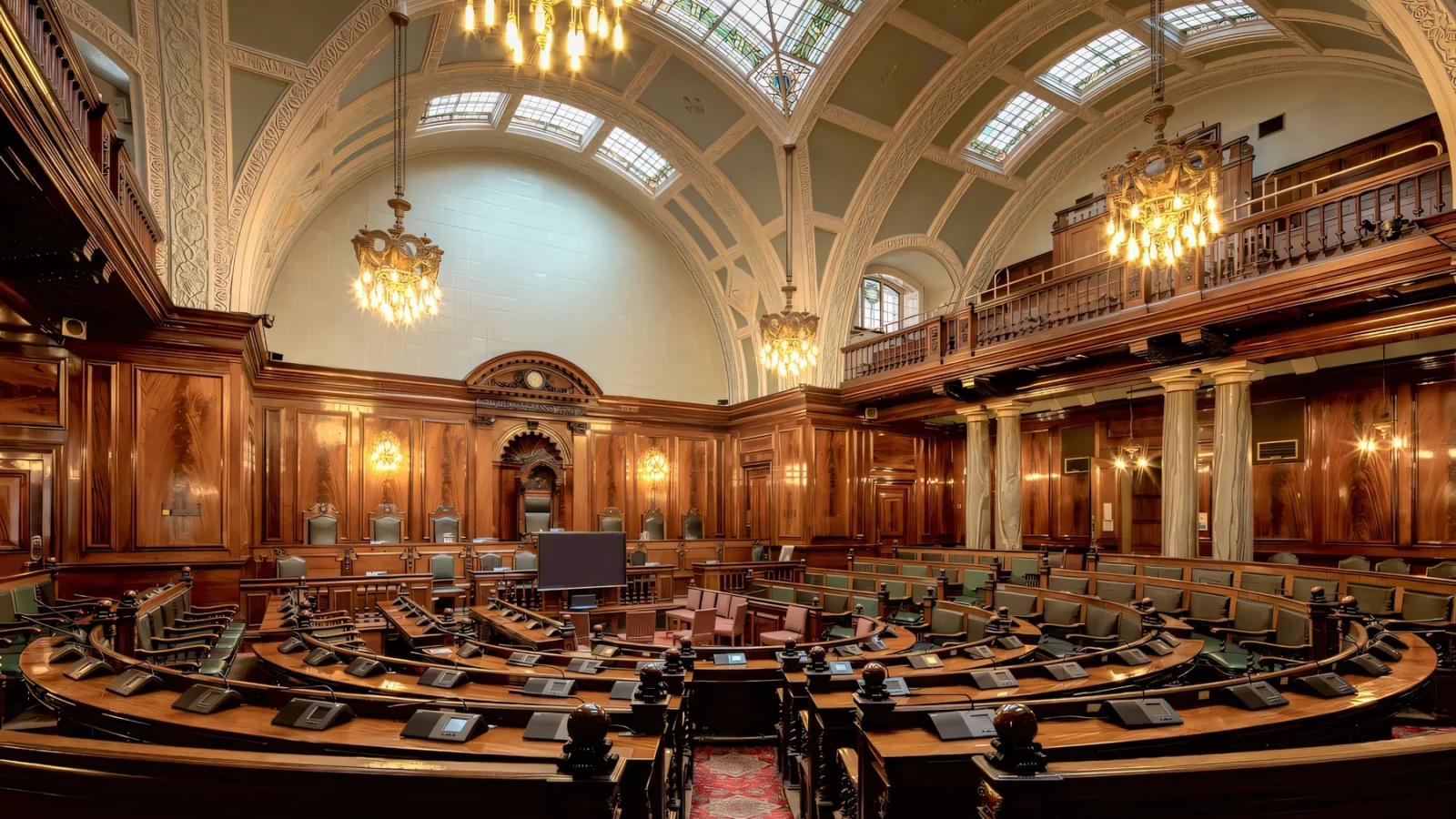
The Municipal Structures Act was never meant to require a chokehold to function. Yet somewhere between the quorum call and the minutes of the previous meeting, the Umvoti council chamber last December decided that democratic process was best settled the way disputes get settled outside a shebeen at closing time. Two expelled Abantu Batho Congress councillors showed up believing they still had seats. Their former colleagues disagreed. What followed reportedly involved fists, grabbed phones, bodyguards cocking firearms, and a forcible ejection that made the Speaker’s gavel look decorative.
This is what happens when paperwork becomes optional and everyone remembers they know a guy with a gun.
The Legal Theatre That Preceded the Physical One
The expulsion of the two ABC representatives sits in that familiar South African grey zone where party discipline, municipal law, and actual due process send each other to voicemail. Section 27 of the Municipal Structures Act allows for termination when a councillor ceases to be a party member. The Municipal Systems Act adds its Code of Conduct, complete with disciplinary procedures that theoretically require notice, response, and formal resolution. This process is never quick or quiet. All of it is supposed to happen before the meeting where the expelled person is physically prevented from sitting down.
What Umvoti apparently produced instead was the political equivalent of a landlord changing locks while the tenant is at work. The two councillors either had not received final legal confirmation of their removal, had secured court interdicts restoring their status, or simply believed the party’s internal process was about as legitimate as a taxi rank queue-jumper’s excuse. When they arrived to claim their seats, the council had a choice: follow the paperwork or follow the precedent of every other dysfunctional municipality that has discovered democracy moves faster with momentum and a security detail.
They chose the second option. The Municipal Systems Act does not contain a chapter on this approach.
The Chamber as Combat Zone
TimesLIVE’s reporting of the incident carries that particular journalistic restraint that arrives when a story is too absurd for adjectives to help. Councillors exchanged punches. Bodyguards, reportedly attached to specific office-bearers, drew and cocked firearms inside the chamber. Phones were grabbed, presumably to prevent documentation of proceedings that were themselves becoming undocumented. The two disputed councillors were forcibly removed. The meeting then continued. Nothing says “local governance” like concluding agenda items while someone’s lip is still swelling.
The Speaker, empowered by Section 36 of the Structures Act and local Standing Rules to maintain order, apparently presided over a room where order had already emigrated. Municipal security, if present, either participated, watched, or were outnumbered by private muscle. The quorum requirement, that basic threshold of democratic legitimacy, was presumably met by whoever remained standing after the scuffle. Whether those present included the people legally entitled to vote on behalf of their wards became, in the moment, a secondary consideration.
This procedural absurdity lies at the core of the rot. The rules assume good faith. They assume that when a councillor’s status is disputed, the dispute runs through courts or council votes, not through who can summon more intimidating backup. Umvoti treated the chamber like a territory to be held rather than a forum to be conducted.
What the Firearms Were Really For
The cocked firearms deserve their own mention because they clarify what kind of politics this is. Bodyguards in South African municipal politics are not new. The country has documented cases of councillor assassinations, political hits, and intimidation campaigns that make personal security a rational expense. But there is a gap, apparently invisible to the Umvoti delegation, between protection and projection. A firearm drawn inside a council chamber is not defensive. It is a punctuation mark. It says the debate is over because I have decided it is over.
The Municipal Structures Act does not grant security personnel any authority over council composition. The Standing Rules of Order do not include a “firearm clause” for resolving points of order. SAPS involvement after such incidents typically investigates assault, intimidation, and illegal possession or brandishing, because the chamber is not a jurisdiction where private security operates under special dispensation. Yet the presence of these weapons suggests a political culture where the threat of violence has become so normalised that its deployment inside democratic institutions barely registers as escalation.
The Pattern Nobody Pretends to Break
Umvoti is not inventing dysfunction. It is participating in a broader municipal tradition where institutional norms erode from the inside while everyone maintains the exterior architecture. The council chamber looks like governance. The agendas look like governance. The press statements afterward will sound like governance. But the actual transaction of power increasingly resembles the transactional intimidation that operates in other spheres of South African life where formal process has failed.
The consequences, where they arrive, are familiar. Criminal dockets move slowly if at all. Disciplinary processes become further arenas of political contest. Provincial intervention under Section 139 of the Constitution, the nuclear option that dissolves council and appoints an administrator, hovers as threat without quite landing. Reputational damage matters only to people who believed the reputation was genuine in the first place.
What does not happen is the straightforward application of rules that exist precisely to prevent December council meetings from becoming bare-knuckle contests. The Municipal Structures Act and the Systems Act are not obscure documents. They are not suggestions. They are the legal framework within which local government is supposed to operate, and their repeated failure in practice says something about the gap between South African law and South African political reality.
The two ABC councillors, wherever they landed after their forcible removal, represent a constituency that voted for representation and received instead a spectacle. The meeting that continued without them made decisions in their absence, with votes cast by people who had just demonstrated their commitment to procedural fairness through physical assault. This is the machinery of democracy mimicking a street fight, as requested. The joke is that nobody involved seems to recognise the parody. They are simply doing what works, what has worked before, what will work again until someone with actual enforcement power decides that council chambers are not taverns and democratic mandates are not settled by who brings more backup.
The gavel, for the record, remains available for purchase at most stationery suppliers. Whether anyone in Umvoti remembers what it is for is a separate question.