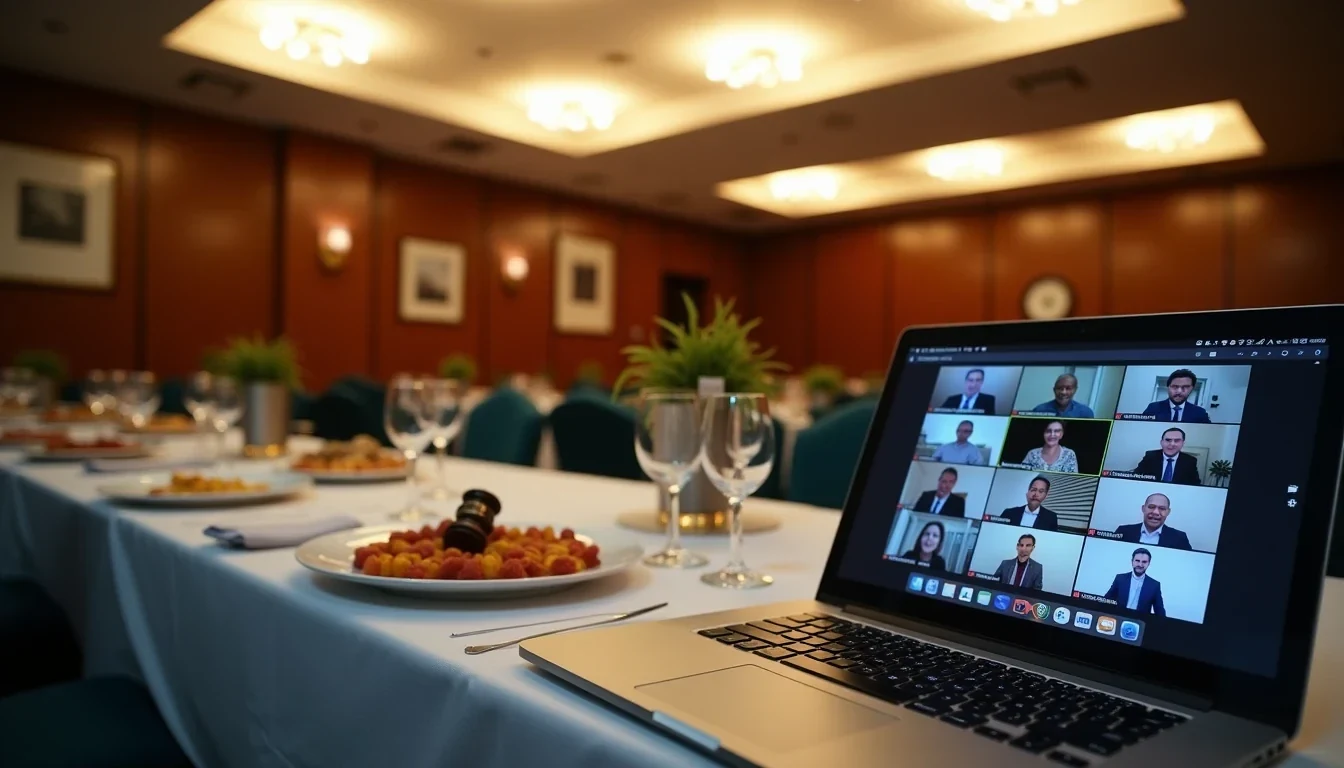
The City of Cape Town has built a two-tier system for its council chamber, and only one tier gets to sit in the actual chairs. While elected councillors debate the city’s future through glitchy video calls and muffled microphones from spare rooms across the metro, the Democratic Alliance held an in-person party gathering in the same chamber this July, complete with the red leather seats, the podium, and the faint smell of institutional authority that comes with physically occupying a space built for democratic power.
The footage landed as you would expect. Opposition parties saw proof of a rigged game, not a party using a public facility. The African National Congress and Economic Freedom Fighters have both pressed the same question with increasing volume: if the chamber is too hazardous for councillors and too expensive for ratepayers to maintain as a functioning democratic venue, how did it become safe and affordable the moment the DA wanted to host its own people for a private function?
The Speaker’s Three Defences
City Speaker Felicity Purchase has offered many explanations. Virtual council meetings, she insists, save the City R1.2 million annually. That figure breaks down into R750,000 in councillor travel allowances, R200,000 in catering, and R250,000 in utilities. The savings are real enough, but she does not address why those savings matter selectively.
Safety forms the second pillar. Purchase and the DA continue to cite COVID-19 variants, specifically referencing the Omicron-X strain identified in May 2026, as justification for keeping elected representatives and the public out of the chamber. Councillor Phindile Mfeka of the EFF cut through this with the precision of someone who has heard one excuse too many: “Are COVID-19 variants selective? Do they only infect opposition councillors and the public, but spare DA members having a good time?”
The third defence is accessibility. Virtual meetings, the City claims, allow broader public participation through live-streaming and digital submissions. This would be more convincing if the same City did not charge R18,500 for a four-hour block of chamber time, or R35,000 for a full day. This effectively prices most civic organisations out of the physical space that supposedly belongs to the public.
The Price of Pretending
The City’s Municipal Facilities Rental Policy, updated in November 2025, technically allows any registered political party to apply. The theory is open access; the practice is something else.
The ANC discovered this in October 2025 when it applied to host a provincial executive committee meeting in the chamber. The City denied the application, citing a pre-existing booking conflict and insufficient lead time. The ANC had submitted 45 days in advance, but the policy demands 60. Councillor Luvuyo Nondabula called the DA’s July gathering “a slap in the face of democracy” and framed the broader pattern with a phrase that has stuck: “The DA wants budget democracy for the public, but premium, in-person treatment for their own party administration.”
The EFF inquired about a press conference in April 2026. After receiving the fee structure and security requirements, they did not submit a formal application. The GOOD party managed to rent Committee Room 2 in March 2026 for a policy workshop, but avoided the main chamber entirely, citing cost and what they termed the “optics” of using a space so visibly associated with DA control.
What Security Means in Context
Security protocols shift depending on who owns the room that day. Official council meetings involve bag searches, metal detectors, uniformed City Law Enforcement and SAPS officers, and monitored public galleries. Access to the chamber floor is restricted to elected councillors and authorised officials.
Private party events operate differently. Access is limited to approved guest lists. Attendees often enter through a side entrance rather than the main public access point. Metal detectors may appear, but the visible security presence is reduced, focused on controlling entry rather than managing public order. The base rental includes two security officers for four hours; anything beyond that costs extra.
The implication is difficult to miss: the chamber is secure enough for a closed guest list of party members, but somehow too risky for the same councillors who would attend official meetings, and for the public those councillors represent.
The Rental Fiction
The City’s defence rests heavily on the claim that any party can rent the chamber. This is true in the same way that any citizen can theoretically afford a lawyer, or any patient can theoretically access a specialist. The barrier is not prohibition; it is design.
The R18,500 fee for political parties is justified through a cost-recovery model covering utilities, cleaning, security personnel, technical support, and wear-and-tear. Non-profit organisations receive a 50% discount, paying R9,250 for the same four-hour block. Additional charges accumulate quickly: R4,000 per hour for overtime, R5,000 flat fee for live-streaming setup, R750 per additional officer per hour.
The policy also grants the City Speaker’s office final approval authority, with discretion to deny applications based on “operational” concerns or “reputational considerations.” This clause sits quietly in the document, available whenever the open access narrative needs a practical correction.
The Picture That Emerges
The July footage captured not merely a party using a room, but the physical arrangement of power in Cape Town: the DA inside the chamber, everyone else watching through screens, and the public invited to participate digitally while the real space is rented back to the people who already control it.
The City’s estimated R1.2 million in annual savings from virtual meetings is not trivial. But neither is the message sent when those savings are collected from democratic process while the infrastructure of that process is made available for private party functions at rates that filter out meaningful opposition.
Speaker Purchase’s statement from mid-July insisted that “our priority remains the safety of our councillors and staff, and the prudent management of public funds, while ensuring maximum public engagement.” The opposition’s response writes itself: maximum public engagement, in this formulation, happens at maximum distance. The chamber itself is reserved for those who can pay, who can plan sixty days ahead, and who already hold the keys.